All Activity
- Past hour
-
As we have seen in the past with countless IOT devices, buying something that requires third party closed-source infrastructure to function is likely to be bricked one day. One day Google might come around with a big-tech-money, buy Eshtek to own a small part of the tech stack or a license or something and abandon everything else ... Yes, thanks to trueNAS my data could probably be restored, but I still payed at least 600€ (2 licenses) for a then dead service that I would have liked to continue to use. This would only take effect if it comes to a reinstall but it will happen eventually. Don't get me wrong, the fact that its a one time purchase is great, but it could be even better. You are right, I forgot about the option to tinker with the underlying trueNAS. Thanks for the reminder :D
- Today
-
Truenas itself already offers a lot of possibilities, you have the standard rsync which you can use to backup to virtually any other type of NAS and you have the replication task which you can use to backup to another truenas/hexos server. If you're looking for options for more tech savvy users, truenas already offers them, there is no need to wait for Hexos to implement them. 🙂
-
I assume the online activation is there because HexOS is a commercial product. Shutting down activation would really only make sense with the shut down of Eshtek as a company (or the end of development and sale of HexOS). I think it is very likely that if that ever happens they will remove the activation requirement before shutting down deck.hexos.com. And even if they decided, for some bizarre reason, to brick HexOS, the underlying TrueNAS SCALE would still work just like it does now, so nobody would be truly cooked anyway.
-
 Martin-PM2 joined the community
 -
I read that too :( I hope they change their mind about that. If HexOS gets sold in a few years and the buyer decides to shutdown the activation service (which is not unlikely) we are cooked. I wouldn't mind a more complex solution as an option for tech savvy customers. A simple open source "connection broker" running on docker would be great, don't you think?
-
I believe they have confirmed that HexOS will be able to be used completely offline. If I recall correctly, Offline activation may not be supported and for buddy backup a method will be possible, but the setup may not be as easy/convenient. Lastly I believe it's undecided if outbound connections can be disabled like the deck outside of air gaping the system.
-
Hi everyone, I was reading the post about the upcoming local GUI, when a question came to my mind. Will there ever be a "true local" solution in the future, that does not depend on HexOS' Servers at all? I am quite concerned about this, because as long as a connection to offsite infrastructure is needed I will not be able to redo my HexOS install if said infrastructure is out off order. Which is not unlikely to happen one day. Same goes for the buddy backup, will there be a way to establish a peer to peer connection without relying on HexOS' servers? I really like the idea of HexOS but once I bought a license and downloaded my ISO I would prefer to be independent from you, if I want to. Regards, D3I5
-
 user3298324982 joined the community
 -
 D3I5 joined the community
 -
 MarkOZ joined the community
 -
It's here!!! https://forums.truenas.com/t/truenas-25-10-1-is-now-available/60830. Can't wait until this is integrated into HexOS!
-
Is it supported now?
- Yesterday
-
 Joe729 joined the community
 -
 rabidkitty changed their profile photo
 - Last week
-
One thing to keep in mind, and this is true for most folks who look at Youtube videos to do their installations. Like the video above, that installation is on an old and getting more out of date version of TrueNAS. The bigger the gap, the weirder errors. For my first installation of Nextcloud I followed this video and completely messed up HexOS. I am betting I made an unwise security change because nothing would run at all. Doing installs from out of date videos will probably make more work for the dev team since they probably have the TrueNAS knowledge to do things right the first time and can't predict what you did differently. I would never say stop experimenting because that would make me a hypocrite. Just make full backups.
-
 Arne joined the community
 -
 sunshine joined the community
 -
ZCMK123's post got me up and running. Check it out and see if it helps you.
-
You are a rockstar. This got me up and running again.
-
 Shirogane joined the community
 -
 Mongoose joined the community
 -
 Gildner99 joined the community
 -
I can't find where to delete this thread. I've posted a new one in the support category.
-

Adding SMB Share as Additional Storage for Application
Fasio replied to kosmro's topic in Applications
I'm guessing, that the share is on the same server, as the app. In that case, why aren't you adding the storaga as a Host Path? -
Thanks for the explanation. Im still planing everything out so I can't really say id use it. But its a nice option.
-
 Hardik Gehlot changed their profile photo
 -
This is super kewl. I think I'm changing my mind to a Ugreen, I'm a data hoarder so this might work for my benefit.
-
 funky33 changed their profile photo
 -
Hey, I had the same problem and found out, that I first had to shut down my VM. Then the automatic creation worked. Afterwards your VM won't boot directly, but that can be solved by going into the "devices" settings of your VM and then update the "NIC" device to use the new br0 network interface. Kind regards
-
 rnica changed their profile photo
 -
Hi, I've never worked with anything other than classic Windows(XP, 7, 10, 11) for my "server" and I'm planning to switch to HexOS during the christmas vacations. If you spot something bad or have suggestions let me know please! Also I have a few questions: 1- Do I have something to do to let Plex use the iGPU to transcode (other than selecting hardware transcoding in Plex's settings). 2- I want to mirror my boot drive for reliability (I know there's an option for it in the setup). Do they have to be the same size or I can pick two SSDs I already have laying around and I'll simply be limited by the smallest? 3- For the boot drive, the minimum is 16GB, but do I gain anything if I use a 250GB or 500GB disk? Currently I have two old SSDs 64GB and 120GB available, I have some bigger but I dont want to "waste" them if only 16GB will get used. 4- To prevent fragmentation in the pools, I've seen discussion about using a "scratch disk" or a "download disk". I have a 500gb NVME disk I'd like to use for this. Do I set it as it's own pool (I don't need redundancy for this)? Is there a setting in the OS to set it has a temporary file drive? 5- Where are the apps (plex, home assistant, etc) installed? The storage pools, the boot drive, a drive dedicated to them? 6- I've heard LSI cards can run hot (a lot less with the one I selected), can I monitor the temperatures of the components (cpu, mobo, LSI, etc) in the OS? Specs: CPU: Intel i3-8350k (old) Mobo: Gigabyte Z370 HD3 (old) RAM: 16Gb (old) HBA: LSI 9400-16i + SAS to SATA cables (new) Case: Jonsbo N5 (new) 2x 2.5" SSDs boot (old) 1x NVME 500GB for downloads and temporary files (old) 4x 18TB (new drives) 3x 12TB (old drives after I've transferred everything on the 18TBs) 4x 4TB (I have them laying around, might as well use them) Thank you!
-
I have transplanted pools between several test builds, with new OS installs each time. I've always been able to import the pools in the TrueNAS interface without issue. I usually run a scrub afterwards but has always 'just worked' for me... ...Just remember the usual caveats of having backups etc.
-
From what I understood it was a price issue, I wonder if the licenses could be upgraded for extra at some point.
-
yes you would need to either go back to the 192.168 subnet or Vlan for the hex os port to run as 192.168 and make the ACL's to connect back to the 10.10
-
I would take the new router and mirror the current /24 ip structure.
-
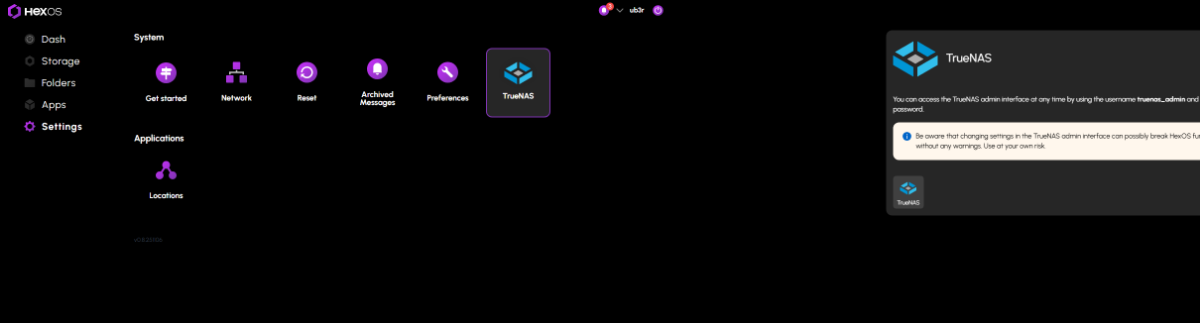
If you are in Windows use a network scanner like Angry IP scanner or NMAP/Zenmap to do a network scan . You should see the hostname that you setup the NAS to have ,use that IP and HTTPS://i.p. here and you should see the truenas screen. Also you can use this option from the HEXOS DECK view ::::: SEttings - truenas- popout window truenas button

-
So I cant speak on the uGreen HW but I can tell you that if you decide to find normal computer hardware plopping in the boot SSD and hard drives it will take off and run " NOTE depending on the network chipset you have" without any hitch. I am running the same SSD that I started HEXOS "since launch" and have tested about 12 different motherboard cpu combos and the only issue has been a network chipset that the underlying Linux os didnt like.,
-
So I have played with a lot of different hardware on my HexOs journey. For the time I have landed with using a i3 8350k 32gb of ram and running 16 drives. For your use case the storage is going to be your money pit. Without knowing where exactly where your needs are I could say make sure you bulk up there where as in RAM starting with 16gb will get you going but having more will help ZFS Cache.
-
You could do some Slow but useful AI stuff