All Activity
- Yesterday
-
 Andrew Minton joined the community
 -
 Dewey joined the community
 -
 Isaac Nelson joined the community
 -
 Keylein joined the community
 -
 Rehman Mansoor joined the community
 -
 Shumms Ullah joined the community
 -
 Nishad Mehta joined the community
 -
 xlad joined the community
 -
 Dariusz Swiecki joined the community
 -
 Rod Biddle joined the community
 - Last week
-
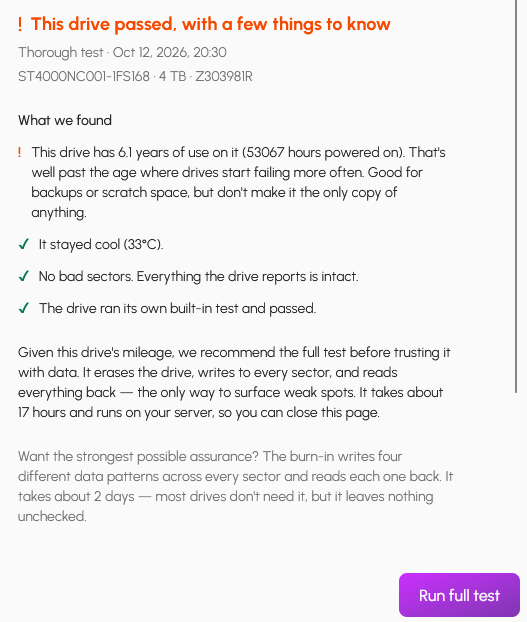
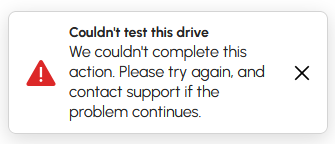
Thanks for the screenshots. I checked your server without changing anything. The drive shown is part of your storage pool, and its saved Thorough test passed with an age warning. A Thorough test checks the drive without erasing it. A Full test writes across the entire drive and erases its contents, so HexOS blocks it on drives that are already part of a pool. The confusing part is on our side: the report recommends a Full test even though this drive cannot safely run one, then shows an unhelpful error. I have recorded that for correction. This is separate from TrueNAS removing its SMART scheduling interface. Drive testing is still available in HexOS. You do not need to remove any drives, change your pool, or repeat the passed test to clear this message. We have made a fix to ensure that the thorough test is only available on drives not attached to a drive pool, since it deletes them as it tests.
-
Any drive that I am trying to run a 'full test' on does not run and just an error pops up. Is this related to the removal of SMART tests from TrueNAS? Or just a feature that isn't quite ready yet?

-
there is a short back up restore process to follow HexOS deck > Settings > TrueNAS In the truenas ui of original ssd. systems tab on left side of screen advanced settings from the systems menu click on manage configuration download configuration What to do with new ssd install hexos during the claiming process when asked if hexos should configure your storage drives, use the skip button in the truenas ui go back to manage configuration in advanced settings upload the config file from system 1 go to storage tab in truenas ui select import pool and follow the prompts.
-
Thanks for confirming. If I reinstall hexos on a new drive, will it easily pick up in the same state I left it?
-

Media and Videos folders keep recreating themselves after deletion
squijello replied to squijello's question in OS & Features
Thanks, Mobius. I think I’d prefer to wait for the Custom Update functionality you mentioned, as that sounds like a much better way to handle this. It’s a pretty minor issue, so I’d rather leave things as they are for now than go through the process of uninstalling and reinstalling Jellyfin. Appreciate your help! -
Unfortunately because of how TrueNAS is designed the boot drive cannot be used as part of a storage pool. I don't imagine this will change anytime soon if ever. Currently your options are 1) leave things how they are 2) get a new smaller drive 16gb-256gb and install hexos on to that and repurpose your 1tb ssd 3) <Advanced & unsupported use-case> install hexos on to a partitioned virtual drive via proxmox
-

Media and Videos folders keep recreating themselves after deletion
Mobius replied to squijello's question in OS & Features
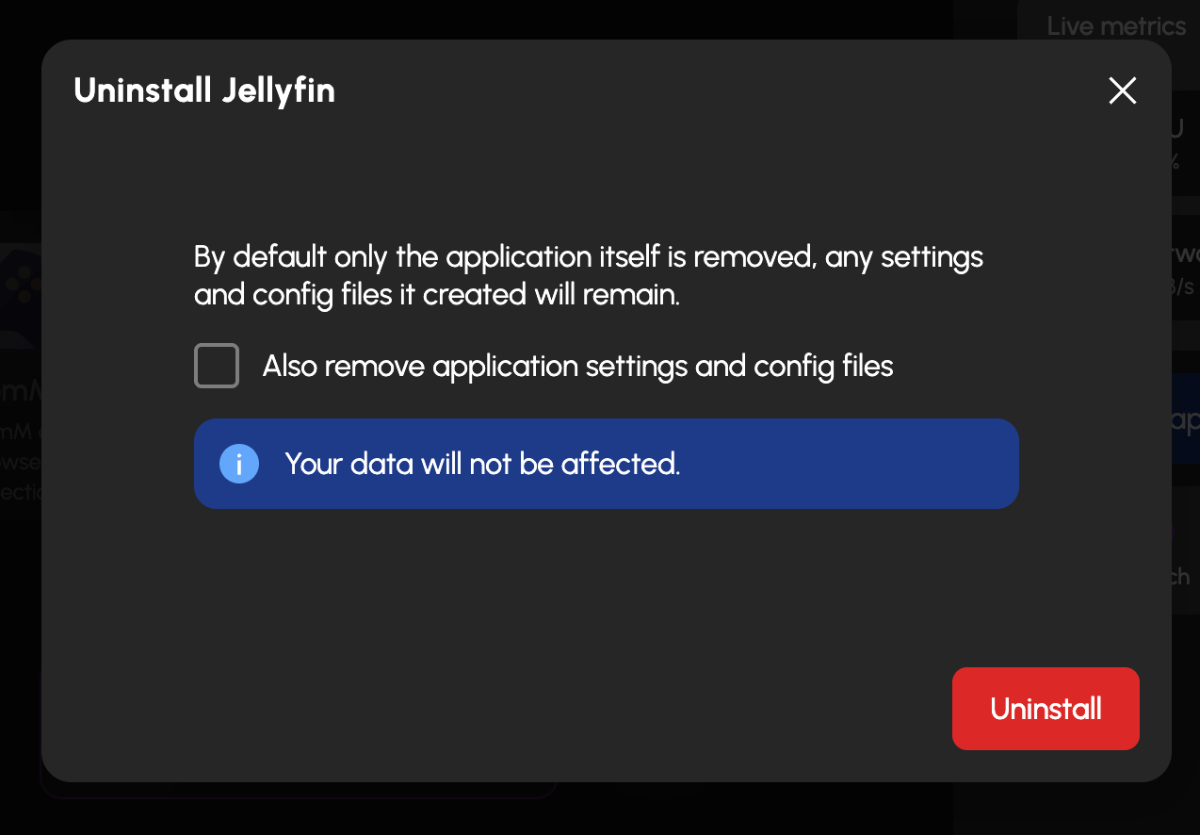
seems like the custom update was not yet implemented in the the official version of HexOS yet. alternatively you can delete the jellyfin app while leaving "Also remove application settings and config files" unchecked and then reinstall via custom install it will not delete the data from you current jellyfin installation and you will be able to pick up from where you left off
-

Built-in Dynamic DNS Service & Reverse Proxy
cyildiri42 replied to Patrizia's topic in Roadmap & Feature Requests
even for full-local setup, having an integrated reverse-proxy would be useful. on my home router, I setup a DNS record pointing to my server on truenas, I'm running NGINX Proxy Manager, and I have to manually configure subdomains for each app/service I install. I also created a CA Cert for my homelab to have completely local SSL since hexos isn't aware of this, it still launches apps as <local-ip>:<port> without HTTPS/SSL which makes this launch button useless for me. I just setup a folder of bookmarks on my chrome bookmarks bar for each app. remembering ip addresses/port numbers, and lack of SSL is a dealbreaker for my home lab. some services I host are missing features because they dont work without SSL (e.g. install a web app as a PWA. lots of services support this: immich, jellyfin, open web ui, home assistant, etc.) would be a game changer to have builtin: Certificate Authority (create cert + key + http page to assist in installing it on various devices) SSL Cert for homelab domain (e.g. jellyfin.home-lab.local) Reverse Proxy - subdomains for each app automatically, using the SSL Cert for your homelab Launch button for app would automatically open the subdomain URL (https://jellyfin.home-lab.local) instead of <local-ip>:<port> -
Seems the installation did not partition the OS at all on installation. I happened to use a 1 TB NVME I had laying around, so it's pretty wasteful. I'd like to be able to at least use that excess space for caching. I was less bothered by it back when storage wasn't expensive, but now every bit matters. I installed way back when you first launched, so if you already changed this, let me know how I can fix it.
-
Media and Videos folders keep recreating themselves after deletion
squijello replied to squijello's question in OS & Features
I must be doing something wrong, I am not seeing that option.
-
Media and Videos folders keep recreating themselves after deletion
Mobius replied to squijello's question in OS & Features
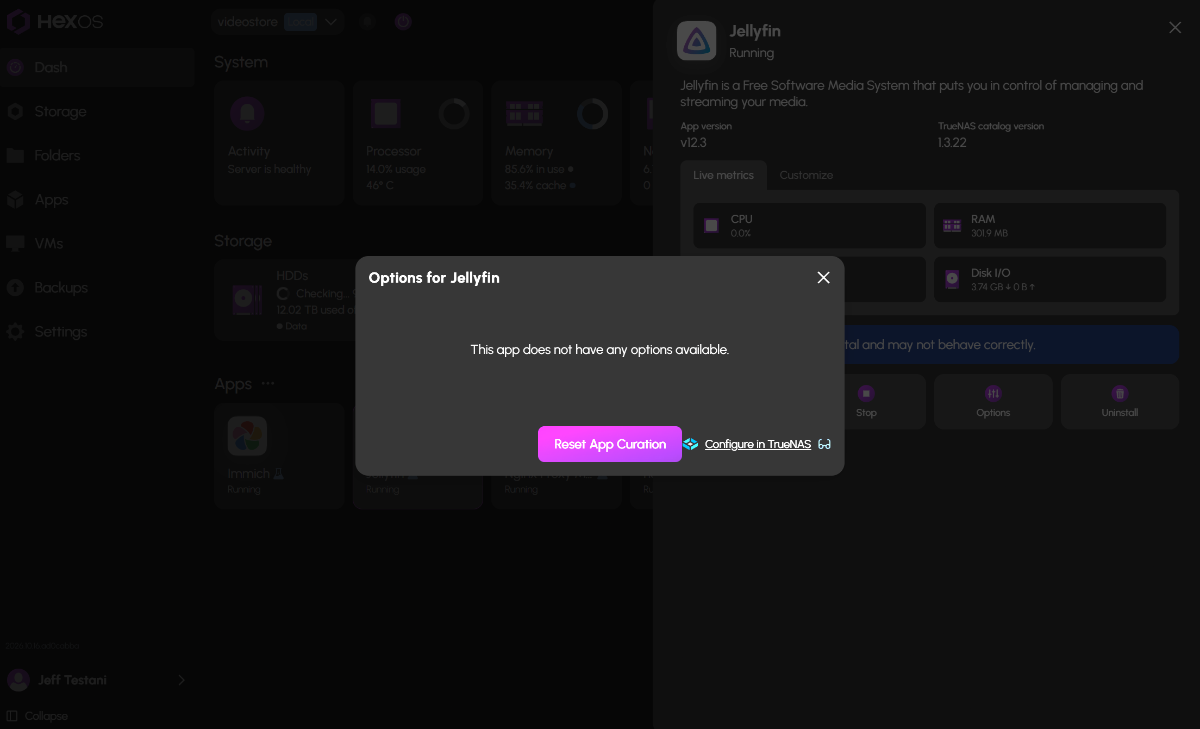
After enabling expert mode Find the jellyfin app card on hexos > options > custom update that should help you modify the current installation -
You would not lose access to HexOS however there MAY be features of HexOS that do not work as intended as well as bugs.
-
Media and Videos folders keep recreating themselves after deletion
squijello replied to squijello's question in OS & Features
Thanks, Mobius. I enabled Developer Mode, but because Jellyfin is already installed, selecting it from either Installed Apps or the catalogue opens the existing application details. I don't see a Custom Script option. Is there a way to modify the existing curated installation script and update its self-healing configuration without uninstalling or reinstalling Jellyfin? I'd like to preserve my existing installation, libraries, plugins and settings. -
 jamo changed their profile photo
 -
@jonp@Mobius do you think there are breaking changes that would break hexos if I upgraded on launch? how much effort do you think it will take to support? (low/med/high) worst case, if I upgraded early, I would loose access to hexos functionality until it's officially supported, right?
-
Media and Videos folders keep recreating themselves after deletion
Mobius replied to squijello's question in OS & Features
You can try modifying the hexos install script and custom installing to remove the folders you don't want. it should be as simple as removing a few lines in the ensure directories exist and storage sections of the install script -
 @mill3000 I can confirm it is fixed. thread can be closed, thank you.
 -
Let me know how it goes! -- Orion
-
Media and Videos folders keep recreating themselves after deletion
squijello replied to squijello's question in OS & Features
Thank you, that makes sense. I'm fairly certain I originally installed the curated version of Jellyfin, so the self-healing functionality may explain what's happening. My Jellyfin installation is now configured exactly how I want it, with its existing libraries and storage mappings. I've removed the unused Media and Videos locations from Jellyfin, and everything functions correctly without them. Is there a supported way to update HexOS's curated Jellyfin configuration to reflect my current setup, so self-healing no longer recreates those two datasets? I'd prefer to retain the curated installation and its other benefits, including self-healing where appropriate, without reinstalling Jellyfin, losing any existing configuration, or introducing unnecessary datasets and SMB shares. Essentially, can HexOS recognize that these folders are intentionally unused rather than treating their absence as something requiring repair? -
feature-request P2P Remote access to files and applications.
Mobius replied to Weezenger's topic in Roadmap & Feature Requests
We are looking into remote access -
Media and Videos folders keep recreating themselves after deletion
Mobius replied to squijello's question in OS & Features
If you installed our curation of jellyfin the self healing function of HexOS may be bringing back those datasets. They are not created until you create them manually or install a curated app that uses those datasets it is not currently possible -
 There is a built-in file browser in the deck already so that you can already now access your files from everywhere. Concerning remote access to the apps, this has already been requested on multiple occasions and it's currently being analysed IIRC
 -
 Hi, Is there any feature of remote access planned for the future ? Not remote management but remote access to files (ala ZimaOS https://www.zimaspace.com/docs/zimaos/remote-access) or even access to application like jellyfin (a remote dashboard would be awesome). The goal would be to simplify remote access by removing all the tailscale, wireguard, port forwarding shenanigans that can be overwhelming for non experienced users (like me) to setup. Of course to be more privacy friendly I'm talking about something that would be direct between the user and their hexos home server. I don't think that all the photo backup / sync tool suite that Zima offer is necessary as apps (like immich) exist for that but I think that setting the remote access is a major point of friction that prevent less technical users from using them, and pushes them toward systems that offer those suites like Synology or Zima. Even with all my love for the Hexos project I know that i could not recommend it to my parent for exemple without remote access build in. Even though they have been using a NAS for years now. (a WD one).
 -
I have attempted it on the N5 Air but I had a bit of bad luck with my unit. I'll be trying again on the replacement unit.
-
Media and Videos folders keep recreating themselves after deletion
squijello replied to squijello's question in OS & Features
One additional thought: could this behaviour be related to HexOS's curated Jellyfin installation? I originally installed Jellyfin through HexOS, which I understand automatically preconfigures media libraries and storage locations. We subsequently removed the unused Media and Videos locations from Jellyfin itself. Could HexOS still consider those folders required by the Jellyfin curation and recreate them during its application-management or upgrade process, even though Jellyfin no longer uses them? Or does HexOS recreate any missing folders assigned under Settings → Default Locations, regardless of whether an application actually requires them? I'm trying to understand whether this is an application-specific dependency or a broader default-folder provisioning behaviour. -
Media and Videos folders keep recreating themselves after deletion
squijello replied to squijello's question in OS & Features
Thanks for the suggestion. I found the Default Locations settings, and I can see that Media and Videos are both assigned to their respective datasets. What I'm trying to understand is what purpose these two default folders actually serve. HexOS already has separate Movies, Shows and Music folders, which I'm using, and none of my applications appear to reference Media or Videos. I also noticed that Documents and Downloads are listed as "Not Created." Why can't Media and Videos be configured the same way? If I change their default locations and delete the existing folders, wouldn't HexOS simply recreate them at the new destinations during the next upgrade? Ideally, I'd like to disable default folders that aren't needed rather than relocate them. Is that currently possible, or are Media and Videos required for some underlying HexOS functionality?